AMLR 2027: what changes for obliged entities
The EU Anti-Money-Laundering Regulation applies from 10 July 2027 — and it is directly binding.
Executive summary
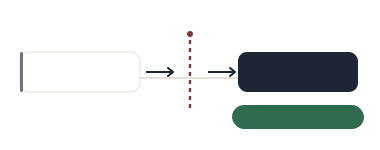
The AMLR applies from 10 July 2027.It moves core AML duties into a directly applicable EU regulation.Offices should prepare now by making processes versioned and evidence-based.The AMLR replaces much of the patchwork of national transpositions with a single, directly-applicable EU rulebook from 10 July 2027. Because it is a regulation, not a directive, its core rules apply uniformly without waiting for national law.
Expect tighter, more harmonised customer due diligence, an EU-wide cash-payment limit, clearer beneficial-ownership rules and a new EU authority (AMLA) overseeing the regime. Risk assessments, policies and procedures will need updating to match.
The practical move now is to get your processes and records into a shape that maps cleanly onto the new rules — so the cutover is a configuration change, not a scramble. Being a step ahead of the deadline is far cheaper than catching up after it.
Who this applies to
This guide is for obliged entities that currently follow national AML transpositions and need to understand the operational shift to the EU single rulebook.
- Notaries, estate agents, accountants, tax advisors and lawyers in scope
- TCSPs and high-risk corporate-service structures
- Offices with cross-border clients or branches
- Organizations that need policy, training and risk-assessment updates
- Teams that want to avoid rebuilding manual procedures twice
Legal and supervisory context
Regulation (EU) 2024/1624 creates a directly applicable AML rulebook. That does not mean national supervisors disappear, but it does mean many core duties become harmonised at EU level and should be mapped article-by-article.
The practical challenge is operational: policies, risk assessments, onboarding questions, EDD routes, cash controls, beneficial-ownership checks and training materials all need to know which rule applies today and which rule applies after cutover.
What the office must actually do
The office should inventory current AML procedures, map them to existing national law, prepare AMLR article mappings, update policies and training, and run a controlled cutover before the application date.
- Create a current-state AML control map.
- Identify workflows affected by AMLR changes.
- Update BWRA, policies and training.
- Prepare cash-limit and beneficial-ownership changes.
- Version rule packs and evidence templates.
- Review with responsible professionals before cutover.
What good evidence looks like
The office should be able to show not only that it updated documents, but that workflows, decisions, training records and client-review calendars actually changed on the right date.
Common mistakes supervisors find
- Treating AMLR as a future legal memo rather than an operating change.
- Updating policies but not workflows.
- Forgetting staff training and adoption evidence.
- Leaving cash controls or UBO procedures hardcoded to old national rules.
- Waiting until 2027 to map the gap.
Practical checklist
- Map current national obligations.
- Map AMLR articles.
- Identify changed controls.
- Prepare policy diffs.
- Train staff.
- Test workflows before cutover.
- Keep adoption evidence.
- Stores rule packs by version and effective date.
- Shows policy and workflow diffs.
- Keeps training tied to rule changes.
- Updates assurance checks after cutover.
- Maintains evidence of adoption.
FAQ
Does AMLR replace every national AML rule?
It harmonises core obligations, but national supervisors, procedures and some national mechanisms still matter.
When should offices start preparing?
Now. The expensive part is not reading the law; it is changing operational workflows and proving adoption.
What happens on 10 July 2027?
The directly applicable rulebook becomes the operative baseline for covered obligations, so workflows should already be mapped and ready.
Official references
From knowledge to compliance
Reading is a start. Sceau turns these obligations into a workflow that runs itself and proves itself.
Book a demo